Finding an NVA Base Camp in Cambodia
I flew in a troop-carrying Huey helicopter for my first two months in Viet Nam. After two gunners on the prestigious smokeship, Pollution IV, were shot, I was lucky enough to grab one of the two positions.
I flunked my flight physical due to colorblindness. That being the only problem I had, the doc said, “It’s your ass.” Good thing, too, as during an “accidental” (smile-smile) excursion into Cambodia’s neutral and sovereign country, I noticed some movement of people and distinct bunker emplacements at my two o’clock position. I told my pilot, “We have some serious activity at two o’clock.”
The AC turned the nose of the ship in the direction of the action at our two o’clock position, which soon became our twelve o’clock position. To see what I was talking about, the AC lowered the nose of the aircraft. This nose-down maneuver made Pollution IV descend toward the ground and the activity. My voice may have risen in pitch when I re-explained what I saw: “We have many enemy troops, all very much on the move now, and bunkers around the perimeter. Do you see it?”
“No.” My pilot, not colorblind, did not see what I saw, as the enemy’s camouflage worked fine on him but not so well on me.
“OH! It’s a damn NVA basecamp,” the AC finally responded.
In an all-or-nothing maneuver, he dropped Pollution IV to a low-level flight across the NVA basecamp from one perimeter to the next, instructing, “Kill ’em all.” We smoked across the fortified enemy stronghold at one hundred-plus knots, with our gunners hammering hard at every enemy we could nail.
I shot into the running crowds of soldiers, into subterranean bunker doorways. I especially remember seeing three NVA soldiers in the far bunker, surprised at our daring race across what they considered safe territory. I pumped my bullets into their open pit bunker, hitting two, with the third taking cover as we passed by.
The battle did not stop once we were beyond the enemy base camp’s perimeter. We flew high into the sky, circling the base camp. Our fifty-caliber machine gun lobbed bullets into the NVA base camp with gravity on our side. The NVA fired their fifty-one caliber bullets up at us, with gravity working against them, and we watched with delight as the tracer-burning bullets failed to reach our altitude.
Meanwhile, the AC worked out the coordinates of the base camp’s exact location, radioed the Air Force, and asked for aerial fire support. A loaded B52 bomber responded, telling us to clear the area ASAP, as he was only five minutes out, which is like being there already.
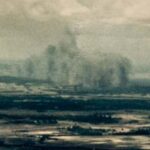
I sat with my 35mm still camera in the ready position and took this next shot of the basecamp lifting 1500 feet into the air as dust particles.
It was a good day of combat, risky as risky gets, “But, momma, that’s where the fun is.”
Cheers,

Gunner on Pollution IV, the Smokeship for the 118th Assault Helicopter Company.
The veteran site: Together We Served asked for 500-word short stories that depict and answer this question:
“Of all the military operations you participated in, including combat, humanitarian or peacekeeping operations, which of these made a lasting impact on you and why?”
Between laying down smoke screens for combat troop insertions or when the flight was shut down for lunch, we on Pollution IV, the smokeship for the 118th AHC, were flying around as a lone wolf, Huey Assault Helicopter looking for any signs of the enemy, or the enemy itself in bunkers, hooches, and villages. We also would find sunken sampans used to transport troops and supplies during the night beneath the water of creeks and estuaries. During the 1969 TET we were also on the lookout for VC flags flying over territory they considered theirs.
They were wrong, and we proved that by stealing their flags and banners. We’d first come in low and slow to shoot the flags and their poles to debooby trap them. We’d go around and fly slower and lower, and I, or other crewmembers, would stand out on a skid, bend down, and steal the flags—a great psychological win for us.
Yes, there was the occasion when the enemy would see us performing this aerial maneuver and shoot at us. We always had a gunship following us to step in with rockets or minigun support if needed.
We stole 13 VC flags. On the last one, the CO asks where we were. My pilot gave him a puff of smoke to locate us from his lofty altitude. When he saw us so low to the ground, he had to ask, “What are you doing?”
My pilot told him, “Stealing VC flags.”
The CO came back with tension in his voice, instructing, “Gain altitude! I don’t want my smokeship shot down.”
My pilot was always quick with a witty comeback, “But this last one is for you.”
The CO permitted us to steal.
Why does this memory stand tall in my mind? It led to the Smithsonian National Air and Space Museum to put me and some of my archival combat gear on display, including the hard-to-find smoke generator to install on the Huey they have on display that has a history of being a smokeship, along with my custom-painted flight helmet and novel, with me on the front cover.
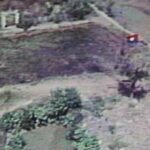
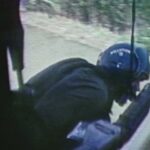
From the battlefield to the National Hall of Fame is a great accomplishment to remember. Here’s the action in photos with me snatching up a flag.
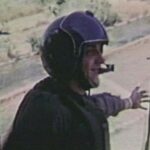
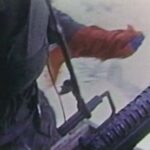

It was another great day of combat where we won. I love winning.
Cheers,
FREE DOWNLOAD. Sixty-six minutes of pure BW adventure from his role as a door gunner on the Smokeship Pollution IV, through his return to Viet Nam thirty years later in ’99, and then his combat gear now on display at the Smithsonian Nat’l Air and Space Museum in Chantilly, Va. Winner of the NY Indy Film Festival ’05.

Buried in the Dirt of Boot Hill is a music video cartoon slideshow. This song is part of the Life Immaculate Trilogy. Perform by Brian Wizard. Vocals and Baritone Uke. Two gunfighters in the late 1800s Tomb Stone Arizona.

The American Heritage Dictionary defines ego as:
- The self, especially as distinct from all others.
- In psychoanalysis, the part of the psyche that is conscious, controls thought and behavior, and is most in touch with external reality.
- An exaggerated sense of self-importance; conceit.
In addition, just for clarification, the difference between an egotist and an egoist as defined by the Oxford Dictionary is:
An egoist, then, might devote considerable attention to introspection, but could be modest about it, whereas an egotist would have an exaggerated sense of the importance of his or her self-analysis, and would have to tell everyone.
Combat ego starts with basic military training’s mental and physical disciplines and conditionings that replace civilian thoughts and behavior to provide a more focused sense of survival in combat using knowledge of tools, weapons, strengths and situational awareness.
“What is the spirit of the bayonet?” asks the Drill Sergeant of his troops in training.
“To kill the enemy, Drill Sergeant!” the trainees shout back in unison.
Real-life combat experience defining the front line of war enhances every aspect of the classroom training, creating an ever-lasting combat ego #2, and inevitably a way of life.
Yes, the term combat ego derives from definition #2, the most positive definition of ego, especially in dangerous environs.
Ego #1 is a given unless the person has only the senses of a vegetable.
Ego #3 is what religions, teachers, and people in authoritative roles express as the only meaning of ego to followers, students, and clients in order to make them feel insecure in their self-confidence, and inferior in their perception of knowledge and equality.
Conceit does not exist when egoist #2 speaks the truth backed by facts and evidence. Ego #2 is a positive attribute. Ego #3 is a dubious trait. When egotist #3 tells egoist #2 that he or she is “wrong” to express pride in personal achievements, egotist #3 reveals a misunderstanding of the full definition of the word ego. Positive reinforcement is a better teaching tool than negative criticism.
Situational awareness is the foundation of all successful combat engagements. It prevents the enemy from delivering a “sucker punch” ambush, allows military personnel to plan winning strategies, and provides the expertise to perform meritoriously in the field of combat.
Living the combat mantra, “Get ready and stay ready,” is situational awareness in full effect at all times. That is ego #2 working for the good of the fighter and its team. This is to be, “Gung ho!” meaning to work for the team’s victory at all costs, with a positive determination to succeed.
In my combat experience as a permanent door gunner on the smokeship Pollution IV during the Viet Nam War, I had to be ultra-aware of enemy movements on the ground. I had to recognize camouflaged ground cover over bunkers and base camps, see trails through the tall grass, barrel flashes, and the source of oncoming enemy tracer fire and retaliate. I had to decide in a split second if a person on the ground was enemy or friendly.
Once a soldier develops a combat ego, practices it, and uses it repeatedly to win deadly battles, he or she does not lose those skills after the battles and a subsequent return home from war.
The skills of combat, including situational awareness and combat ego, need readjustment to merge well into civilian life, and that is an excellent goal for the combat veteran. Once achieved, the merger into civilian life can be peaceful and productive.
After a person learns simple math, “One plus one makes two,” he or she knows that fact for the rest of life. The formula doesn’t change, nor does the person forget the math. Once combat ego integrates into a practiced way of thinking, living, and surviving, it drives a warrior and warrior veteran to achieve more wins, more influence, and more intelligence. This is not to say the readjustment is easy. The warrior veterans need support from family, friends, and society in general.
When egotist #3 states, “You cannot be modest if you have an ego,” their statement is false. Egoist #2 can modestly contradict the negative criticism by citing objective facts and evidence to back up claims he or she has made. It is positive ego #2 when a person says, “This is what I can do,” or “This is what I have done,” and back up the statement by doing what they said they could do, or showing evidence of what they have done.
An insecure egotist #3 may attempt to besmirch egoist #2's accomplishments and record of successful wins by claiming, “You are no better than anyone else.” I hear that frequently. In view of my combat experience, it appears clear that many dead people would argue with that statement if they could, and in light of my winning art competitions, rival competitors see the statement’s error.
Talking about successes in relative conversations does not make a person conceited. All the winner of a competition, or battle, receives are bragging rights and to exercise them is not conceit, it’s the point of the game.
To all egoists of the #2 category, don’t get upset at the uninformed egotists #3. Pass them the dictionary, or this essay, and let them read definition #2.
Enjoy your accomplishments achieved through exercise of your positive #2 ego, whether developed through military training and combat, higher academic education and social recognition, or on-the-job training and experiences that enhance your life and that of the community around you.
Let no one besmirch your achievements or pride. The trick to living in the civilian world with a combat ego as your driving force is to adapt it for positive, peaceful, and productive contributions that improve life for everyone in your world.
Cheers,

Post Script: Having said all that, I am not saying I am free and clear of being a self-centered, egotistical braggart. I have my moments, and they are all in good clean fun, and usually make a good point. For example, “Would you like to buy a copy of my award-winning Viet Nam War video? It is one of the best personal accounts of living through combat while defining the war’s front line from the door of the very prestigious combat assault smokeship helicopter, Pollution IV. This veteran appreciates your supportive patronage. I am modestly humbled by the fact that I was able document nationally important historic feats by the grace of forces greater than myself.”
I’m not bragging, just stating fact. I have what I described above on DVD or an inexpensive video download, and much more as books, sculptures, audio and ebooks, jewelry and my own musical instrument for sale on my website, www.brianwizard.com. I’m very proud of what you’ll find, and hopefully experience.